Showing posts with label actions. Show all posts

Friday, August 24, 2012

Developing Character


INSIGHTS FROM PRESIDENT DAVID O. MCKAY 
(1873–1970)

The following are some classic statements on the development of Christlike character by our ninth President of the Church.

True Greatness
“The highest of all ideals are the teachings and particularly the life of Jesus of Nazareth, and that man is most truly great who is most Christlike. What you sincerely in your heart think of Christ will determine what you are, will largely determine what your acts will be. … By choosing him as our ideal, we create within ourselves a desire to be like him, to have fellowship with him” (in Conference Report, Apr. 1951, 93, 98).

“The true measure of a man is how he spends his time when he doesn’t have to do anything” (quoted by Robert L. Simpson, “Pollution of the Mind,” Ensign, Jan. 1973, 113).

“As a Man Thinketh”
“No principle of life was more constantly emphasized by the Great Teacher than the necessity of right thinking. To Him, the man was not what he appeared to be outwardly, nor what he professed to be by his words: what the man thought determined in all cases what the man was. No teacher emphasized more strongly than He the truth that ‘as a man thinketh in his heart, so is he’ [Prov. 23:7]. … Contentment, complacency, peace—all that makes life worth living—have their source in the mind of the individual. From the same source spring unrest, turbulence, misery—everything that leads to dissolution and death. … It is well for [every teacher and officer in the Church] to pause frequently and take stock of himself to ascertain ‘what he is thinking about when he doesn’t have to think,’ for ‘what he thinketh in his heart, so is he’” (“‘As a Man Thinketh … ,’” Instructor, Sept. 1958, 257–58).

“What a man continually thinks about determines his actions in times of opportunity and stress. A man’s reaction to his appetites and impulses when they are aroused gives the measure of that man’s character. In these reactions are revealed the man’s power to govern or his forced servility to yield” (in Conference Report, Oct. 1951, 8).

We Radiate What We Are
“There is another responsibility correlated and even coexistent with … agency, which is too infrequently emphasized, and that is the effect not only of a person’s actions, but also of his thoughts. Man radiates what he is, and that radiation affects to a greater or less[er] degree every person who comes within that radiation” (“Free Agency … The Gift Divine,” Improvement Era, Feb. 1962, 87).

“Sickness may waste the body, but the true life is the spirit within, that which thinks and feels and loves and suffers and wills and chooses, aspires, and achieves. The purpose in life is to beautify, ornament, develop that something within. To develop a more radiant and lovely character is the true purpose in life” (Gospel Ideals [1954], 357).

The Approval of Conscience
“Thoughts mold your features. Thoughts lift your soul heavenward or drag you toward hell. … As nothing reveals character like the company we like and keep, so nothing foretells futurity like the thoughts over which we brood. … To have the approval of your conscience when you are alone with your thoughts is like being in the company of true and loving friends. To merit your own self-respect gives strength to character. Conscience is the link that binds your soul to the spirit of God” (“Those Sculptors Called Thoughts and Ideals,” Improvement Era, July 1960, 495).

A Clear Conscience
“It is glorious when you can lie down at night with a clear conscience, knowing you have done your best not to offend anyone and have injured no man. You have tried to cleanse your heart of all unrighteousness, and if you put forth precious effort, you can sense as you pray to God to keep you that night that he accepts your effort. You have a sense that you are God’s child, not a mere cog of the state, but a person whose soul God wants to save. You have the strength, the sense of resistance to evil. … You also have the realization that you have made the world better for having been in it” (Gospel Ideals, 502).

The Development of a Grand Character
“Day by day, hour by hour, man builds the character that will determine his place and standing among his associates throughout the ages. … More important than riches, more enduring than fame, more precious than happiness is the possession of a noble character. Truly it has been said that the grand aim of man’s creation is the development of a grand character, and grand character is by its very nature the product of a probationary discipline” (“Man’s Soul Is As Endless As Time,” Instructor, Jan. 1960, 1–2).

Christlike Character
“True happiness is found in living the Christ’s life—on Monday as well as on Sunday. He who is virtuous only at intervals proves that his pretended virtue is but a sham. Such a person lacks sincerity, the foundation of true character, without which happiness is impossible” (Gospel Ideals, 502).

“What is the crowning glory of man in this earth so far as his individual achievement is concerned? It is character—character developed through obedience to the laws of life as revealed through the Gospel of Jesus Christ, who came that we might have life and have it more abundantly. Man’s chief concern in life should not be the acquiring of gold nor fame nor material possessions. It should not be the development of physical prowess nor of intellectual strength, but his aim, the highest in life, should be the development of a Christlike character” (“Obedience Develops Character,” Instructor, Aug. 1965, 301; emphasis in original).

Tuesday, June 19, 2012

Self Mastery


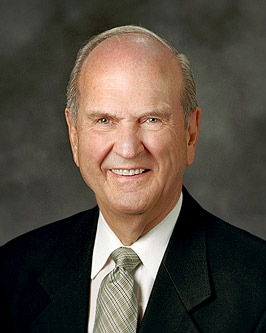
RUSSELL M. NELSON
Of the Quorum of the Twelve Apostles
If our faith be united in prayer that we may be edified together, I should like to speak about our quest for self-mastery. In so doing, I would converse as a loving father counseling one of my own children.

Before you can master yourself, my precious one, you need to know who you are. You consist of two parts—your physical body, and your spirit which lives within your body. You may have heard the expression “mind over matter.” That’s what I would like to talk about—but phrase it a little differently: “spirit over body.” That is self-mastery.

When you arrived as a newborn baby, your little body was master. You had what I call the “I-want-what-I-want-when-I-want-it” philosophy. No amount of discussion could postpone your impatient demands when you wanted to be fed—and now! Like all parents, we anxiously anticipated the first smile, a word, a glimpse at the potential of the spirit within your tiny body. Is there a mother who has not cradled her baby as your sweet mother did, in wistful wonder of the destiny of her dear little one? Even Mary, the mother of Jesus, might have asked such questions:

Baby, lyin’ in a manger, slumberin’ so sweetly,
What you goin’ to be?
Baby, all the world is watchin’, all the world awaits to see.
What will you be?
Baby, sleepin’ in a stable, underneath the heaven,
What you goin’ to say? …
Baby, lyin’ in a manger,
Will you save the world one day?
Through those early years, we parents are properly concerned with physical needs of our children, such as food, clothing, and shelter.

But as you grow older, our concerns shift more toward your spiritual growth, in order that you might achieve your full potential. “For the natural man is an enemy to God, and has been from the fall of Adam, and will be, forever and ever, unless he yields to the enticings of the Holy Spirit … and becometh a saint.” (Mosiah 3:19.)

That requires self-mastery. Remember, “The spirit and the body are the soul of man” (D&C 88:15.) Both are of great importance. Your physical body is a magnificent creation of God. It is his temple as well as yours, and must be treated with reverence. Scripture declares: “Ye are the temple of God. … If any man defile [it], him shall God destroy; for the temple of God is holy, which temple ye are.” (1 Cor. 3:16–17.)

Remarkable as your body is, its prime purpose is even of greater importance—to serve as tenement for your spirit. Abraham taught that “these … spirits … existed before, they shall have no end … for they are … eternal.” (Abr. 3:18.)

Your spirit acquired a body at birth and became a soul to live in mortality through periods of trial and testing. Part of each test is to determine if your body can become mastered by the spirit that dwells within it.

Although your spirit had a veil of forgetfulness placed over it at the time of your birth into mortality, it retained its power to remember all that happens—precisely recording each event of life. Indeed, scriptures warn “that every idle word that men shall speak, they shall give account thereof in the day of judgment.” (Matt. 12:36.) Prophets refer to our “bright recollection” (Alma 11:43) and “perfect remembrance” (Alma 5:18) at that day of decision.

Since thoughts precede deeds, you must first learn to control your thoughts. “As [a man] thinketh in his heart, so is he.” (Prov. 23:7.)

In your quest for self-mastery, full participation in the activities of the Church will help. I’ll mention but a few. A first step comes as we learn together to keep the Sabbath day holy. This is one of the Ten Commandments. (See Ex. 20:8; Deut. 5:15.) We honor the Sabbath “to pay [our] devotions unto the Most High” (D&C 59:10), and because the Lord declared: “It is a sign between me and you … that ye may know that I am the Lord that doth sanctify you.” (Ex. 31:13; see also Ezek. 20:20.)

Another step toward self-mastery comes when you are old enough to observe the law of the fast. As funds are contributed from meals missed, the needs of the poor may be met. But meanwhile, through your spirit, you develop personal power over your body’s drives of hunger and thirst. Fasting gives you confidence to know that your spirit can master appetite.

Some time ago your mother and I visited a third-world country where sanitary conditions were much poorer than ours. We joined with a delegation of other doctors from all over the world. The president of our group, an experienced traveler, warned of risks. In order to avoid water that might be contaminated, we were even counseled to brush our teeth with an alcoholic beverage. We chose not to follow that counsel, but simply did what we had learned to do once a month. We fasted that first day, thinking we could introduce simple food and fluids gradually thereafter. Later, we were the only ones in our group without disabling illness.

Fasting fortifies discipline over appetite and helps to protect against later uncontrolled cravings and gnawing habits.

Another step toward self-mastery comes from obedience to the Word of Wisdom. Remember, it contains a “promise, adapted to the capacity of … the weakest of all saints.” (D&C 89:3.) It was given “in consequence of evils and designs which do and will exist in the hearts of conspiring men in the last days.” (D&C 89:4.) Indeed, as you develop courage to say no to alcohol, tobacco, and other stimulants, you gain additional strength. You can then refuse conspiring men—those seditious solicitors of harmful substances or smut. You can reject their evil enticements to your body.

If you yield to anything that can addict, and thus defy the Word of Wisdom, your spirit surrenders to the body. The flesh then enslaves the spirit. This is contrary to the purpose of your mortal existence. And in the process of such addiction, your life span is likely to be shortened, thereby reducing the time available for repentance by which your spirit might attain self-mastery over your body.

Other physical appeals come during your courtship period. In your youth, you may be challenged by restraints of parents hoping to guide you through this wonderful period of life.

Because the adversary is keenly aware of the power of physical temptation, Alma instructed his son and all of us: “See that ye bridle all your passions.” (Alma 38:12.)

When you marry, you and your eternal companion may then invoke the power of procreation, that you may have joy and rejoicing in your posterity. This divine endowment is guarded by your Creator’s law of chastity. All through the years, remember: chastity is the powerful protector of virile manhood and the crown of beautiful womanhood.

In courtship and marriage, virtue seems to come under attack first. Mental turmoil that trails in the wake of weakness from lust has evoked many a tear from innocent loved ones. Without repentance, tumult within self does not quit either.

Shakespeare expressed such self-conflict as one of his characters contemplating conquest in lust spoke these lines:

What win I, if I gain the thing I seek?
A dream, a breath, a froth of fleeting joy.
Who buys a minute’s mirth to wail a week?
Or sells eternity to get a toy?
For one sweet grape who will the vine destroy?
Prophets have repeatedly cautioned about moral sin. One, for example, warned: “O, my beloved brethren, remember the awfulness in transgressing against that Holy God, and also the awfulness of yielding to the enticings of that cunning one. Remember, to be carnally-minded is death, and to be spiritually-minded is life eternal.” (2 Ne. 9:39; see also Rom. 8:6; Alma 36:4; D&C 29:35; D&C 67:10.)

Now don’t misunderstand me. I would not want you to neglect your body. It deserves daily care. Physical conditioning through regular exercise requires self-mastery too. I marvel at Elder Joseph Anderson, now in his ninety-sixth year. For decades, the strength of his spirit over his body has induced him to swim regularly. But his motivation has never been to attain physical longevity. That has come only incidentally. His desire has been to serve God and His anointed. Elder Anderson has followed what I label as the Lord’s prescription for a long and useful life. Those faithful in “magnifying their calling, are sanctified by the Spirit unto the renewing of their bodies. They become … the elect of God.” (D&C 84:33–34.)

Elder Anderson’s exercise program agrees with the perspective of Paul, who said: “Bodily exercise profiteth little: but godliness is profitable unto all things, having promise of the life that now is, and of that which is to come.” (1 Tim. 4:8.)

Handsome and fit, Elder Anderson personifies this scripture: “Glorify God in your body, and in your spirit, which are God’s.” (1 Cor. 6:20.)

As you work during the productive years of life, whether at home or in the field, in the factory or at a workbench, reputation is built and character is forged as you develop self-mastery. Faithful payment of tithing is part of that process. It defends you against dishonesty or shabby temptations. Courageous accountability for your own actions becomes a cherished prize.

It really matters what you listen to, what you look at, what you think, say, and do. Select music that will strengthen your spirit. Control your speech; keep it free from profanity and vulgarity. Follow the teachings of this proverb: “My mouth shall speak truth; and wickedness is an abomination to my lips.

“All the words of my mouth are in righteousness; there is nothing … perverse in them.” (Prov. 8:7–8.)

As you approach old age, you will face new challenges to self-mastery. Symptoms of the deteriorating body can be painful, even disabling. Deep aches of sadness are caused by the departing of loved ones. For some, these deepening trials come early in life. But when yours are thrust upon you, remember a concept expressed by my father some time after my mother had passed away. Your grandparents had been married for sixty-four years. When someone asked how he was doing, my father simply stated, “I’m lonely, but I’m not lonesome.” Do you know what he meant? Though he was now without his sweetheart, he was so busy assisting family and friends, he had replaced sorrow with service and had displaced self-pity with selfless love. He had found joy in following the timeless example of the Master.

Jesus, our Savior, was born in the lowliest of circumstances. For his baptism he was immersed in the lowest body of fresh water upon the planet. In service and suffering, he also “descended below” all things (D&C 122:8), that he could rise above all things. Near the end of his life, he triumphantly declared, “I have overcome the world.” (John 16:33.) “Look unto me, and endure to the end, and ye shall live; for unto him that endureth to the end will I give eternal life.” (3 Ne. 15:9.) Scriptures tutor us at least twenty-six times * to endure to the end to attain eternal life. Then we will obtain a resurrected body—one that is incorruptible, glorified, and prepared to live in the presence of God.

To reach your highest destiny, emulate the Savior. He proclaimed, “What manner of men ought ye to be? … Even as I am.” (3 Ne. 27:27.) Our loftiest hope is to grow in spirit and attain “the stature of the fulness of Christ: That we henceforth be no more children.” (Eph. 4:13–14.)

You will then be well prepared for that pending day of judgment when, as taught by President Spencer W. Kimball, “the soul, composed of the resurrected body and the eternal spirit, … will come before the great judge to receive its final assignment for the eternity” (The Teachings of Spencer W. Kimball, ed. Edward L. Kimball, Salt Lake City: Bookcraft, 1982, p. 46.)

Remember, my dear one, not an age in life passes without temptation, trial, or torment experienced through your physical body. But as you prayerfully develop self-mastery, desires of the flesh may be subdued. And when that has been achieved, you may have the strength to submit to your Heavenly Father, as did Jesus, who said, “Not my will, but thine, be done.” (Luke 22:42.)

When deepening trials come your way, remember this glorious promise of the Savior: “To him that overcometh will I grant to sit with me in my throne, even as I also overcame, and am set down with my Father in his throne.” (Rev. 3:21.)

Christ is our great Exemplar. I declare, as a special witness, that he is the Son of God and “is the life and the light of the world.” (Alma 38:9; see also D&C 11:28.) We develop self-mastery as we become like him, I testify in the name of Jesus Christ, amen.

Monday, June 18, 2012

Think on Christ


BY PRESIDENT EZRA TAFT BENSON
Of the Quorum of the Twelve Apostles
Ezra Taft Benson
The Product of My Thoughts
To introduce my theme, I want to tell you, in his own words, of a life-changing experience that happened to President George Albert Smith when he was a boy. His words are as follows:

“As a child, thirteen years of age, I went to school at the Brigham Young Academy. … I cannot remember much of what was said during the year that I was there, but there is one thing that I will probably never forget. … Dr. [Karl G.] Maeser one day stood up and said:

“‘Not only will you be held accountable for the things you do, but you will be held responsible for the very thoughts you think.’

“Being a boy, not in the habit of controlling my thoughts very much, it was quite a puzzle to me what I was to do, and it worried me. In fact, it stuck to me just like a burr. About a week or ten days after that it suddenly came to me what he meant. I could see the philosophy of it then. All at once there came to me this interpretation of what he had said: Why of course you will be held accountable for your thoughts, because when your life is completed in mortality, it will be the sum of your thoughts. That one suggestion has been a great blessing to me all my life, and it has enabled me upon many occasions to avoid thinking improperly, because I realize that I will be, when my life’s labor is complete, the product of my thoughts.” (George Albert Smith, Sharing the Gospel with Others, Salt Lake City: Deseret Book Company, 1948, pp. 62–63.)

Thoughts lead to acts, acts lead to habits, habits lead to character—and our character will determine our eternal destiny.

King Benjamin understood this. In the next to last verse of his great discourse recorded in the Book of Mormon, he states: “And finally, I cannot tell you all the things whereby ye may commit sin; for there are divers ways and means, even so many that I cannot number them.” (Mosiah 4:29.)

Then in the last verse he counsels that we must watch ourselves and our thoughts. (See Mosiah 4:30.)

When Christ appeared in America following His resurrection, He stated: “Behold, it is written by them of old time, that thou shalt not commit adultery;

“But I say unto you, that whosoever looketh on a woman, to lust after her, hath committed adultery already in his heart.

“Behold, I give unto you a commandment, that ye suffer none of these things to enter into your heart.” (3 Ne. 12:27–29.)

“Enter into your heart”—why, of course, for as the scripture states: “As he thinketh in his heart, so is he.” (Prov. 23:7.)

So critical is it that we understand the necessity of controlling our thoughts that President Spencer W. Kimball devoted a whole chapter to it in his book The Miracle of Forgiveness (Salt Lake City: Bookcraft, 1969). The chapter captioned “As a Man Thinketh” is the title of a book by James Allen which President Kimball recommended. He quoted from this book three times. One quotation stated:

A man does not come to the almshouse or the jail by the tyranny of fate or circumstance, but by the pathway of grovelling thoughts and base desires. Nor does a pure-minded man fall suddenly into crime by stress of mere external force; the criminal thought had long been secretly fostered in the heart, and the hour of opportunity revealed its gathered power. Circumstance does not make the man; it reveals him to himself.” (Miracle of Forgiveness, p. 105.)

President Kimball also quotes President David O. McKay, who said:

The thought in your mind at this moment is contributing, however infinitesimally, almost imperceptibly to the shaping of your soul, even to the lineaments of your countenance … even passing and idle thoughts leave their impression.” (Miracle of Forgiveness, p. 105.)

The mind has been likened to a stage on which only one act at a time can be performed. From one side of the wings the Lord, who loves you, is trying to put on the stage of your mind that which will bless you. From the other side of the wings the devil, who hates you, is trying to put on the stage of your mind that which will curse you.

You are the stage manager—you are the one who decides which thought will occupy the stage. Remember, the Lord wants you to have a fullness of joy like His. The devil wants all men to be miserable like unto himself. You are the one who must decide whose thoughts you will entertain. You are free to choose—but you are not free to alter the consequences of those choices. You will be what you think about—what you consistently allow to occupy the stage of your mind.

Sometimes you may have difficulty driving off the stage of your mind a certain evil thought. To drive it off, Elder Boyd K. Packer suggests that you sing an inspirational song of Zion, or just think on its words. Elder Bruce R. McConkie recommends that after the opening song, you might preach a sermon to yourself. In fact, he says the finest sermons he has ever preached have been preached to himself.

We should not invite the devil to give us a stage presentation. Usually with our hardly realizing it, he slips into our thoughts. Our accountability begins with how we handle the evil thought immediately after it is presented. Like Jesus, we should positively and promptly terminate the temptation. We should not allow the devil to elaborate with all his insidious reasoning.

It is our privilege to store our memories with good and great thoughts and bring them out on the stage of our minds at will. When the Lord faced His three great temptations in the wilderness, He immediately rebutted the devil with appropriate scripture which He had stored in His memory.

“Look unto Me in Every Thought”
The Lord said, “Look unto me in every thought.” (D&C 6:36.) Looking unto the Lord in every thought is the only possible way we can be the manner of men and women we ought to be.

The Lord asked the question of His disciples, “What manner of men ought ye to be?” He then answered His own question by saying, “Even as I am.” (3 Ne. 27:27.) To become as He is, we must have Him on our mind—constantly in our thoughts. Every time we partake of the sacrament, we commit to “always remember him.” (Moro. 4:3, Moro. 5:2; D&C 20:77, 79.)

If thoughts make us what we are, and we are to be like Christ, then we must think Christlike thoughts. Let me repeat that: If thoughts make us what we are, and we are to be like Christ, we must think Christlike thoughts.

Paul, en route to Damascus to persecute the Saints, saw a light from heaven and heard the voice of the Lord. Then Paul asked a simple eight-word question—and the persistent asking of the same question changed his life. “Lord, what wilt thou have me to do?” (Acts 9:6.) The persistent asking of that same question can also change your life. There is no greater question that you can ask in this world. “Lord, what wilt thou have me to do?” I challenge you to make that the uppermost question of your life.

In his book Youth and the Church, Elder Harold B. Lee included a chapter entitled “Lord, What Wilt Thou Have Me Do?” He began the chapter by relating this experience:

“Some time ago I heard a leader in a high Church position explain his method of endeavoring to arrive at just and equitable decisions in his council meetings. He explained that as problems would be presented, he would frequently ask himself, ‘As measured by the record of the Master’s teaching, just what would He do in this given situation, or just how would He answer this question or solve this problem?’” (Harold B. Lee, Youth and the Church, Salt Lake City: Deseret Book Company, 1945, p. 49.) While he doesn’t mention who the man was, that man in due time would become the President of the Church, President David O. McKay.

My friend Tom Anderson told the following story:

“There was a little crippled boy who ran a small newsstand in a crowded railroad station. He must have been about twelve years old. Every day he would sell papers, candy, gum, and magazines to the thousands of commuters passing through the terminal.

“One night two men were rushing through the crowded station to catch a train. One was fifteen or twenty yards in front of the other. It was Christmas eve. Their train was scheduled to depart in a matter of minutes.

“The first man turned a corner and in his haste to get home to a Christmas cocktail party plowed right into the little crippled boy. He knocked him off his stool, and candy, newspapers, and gum were scattered everywhere. Without so much as stopping, he cursed the little fellow for being there and rushed on to catch the train that would take him to celebrate Christmas in the way he had chosen for himself.

“It was only a matter of seconds before the second commuter arrived on the scene. He stopped, knelt, and gently picked up the boy. After making sure the child was unhurt, the man gathered up the scattered newspapers, sweets, and magazines. Then he took his wallet and gave the boy a five dollar bill. ‘Son,’ he said, ‘I think this will take care of what was lost or soiled. Merry Christmas!’

“Without waiting for a reply the commuter now picked up his briefcase and started to hurry away. As he did, the little crippled boy cupped his hands together and called out, ‘Mister, Mister!’

“The man stopped as the boy asked, ‘Are you Jesus Christ?’

“By the look on his face, it was obvious the commuter was embarrassed by the question. But he smiled and said, ‘No, son. I am not Jesus Christ, but I am trying hard to do what He would do if He were here.’” (American Opinion, December 1971, pp. 13–14.)

And that, my friend, is what it means to be a Christian, even on Christmas eve.

What Would Jesus Do?
Some years ago Charles Sheldon wrote a book entitled In His Steps. It is perhaps one of the greatest best-sellers in American history. It tells the story of a small group of people within a Christian congregation who took a pledge. The pledge was that for an entire year they earnestly and honestly would not do anything without first asking the question, “What would Jesus do?” After asking themselves that question, they were to follow Jesus exactly as they knew how, no matter what the results. The book tells what happened and how their lives were revolutionized.

Just before he died, Charles Sheldon wrote a small sequel to his book entitled In His Steps Today. It tells of Mr. and Mrs. Ralph Ward and their four children. Their two oldest children, George and Alice, attended college while their two youngest, John and Mary, were in high school. Mr. Ward was an official in a railroad office, and Mrs. Ward was prominent in the social, church, and literary life of the city.

One morning as the family was eating breakfast, Mr. Ward told of coming across a book in the library which he and Mrs. Ward had read some twenty-five years earlier, just before their marriage. It was entitled In His Steps, or What Would Jesus Do?

He wondered if the plan was practical, if it really worked. He knew of a large number of people who had taken the pledge to try to act as Jesus who had some interesting experiences. He knew the children were eager to try experiments in the chemical laboratory and in other fields and wondered if they would be willing to conduct an experiment in the world of conduct.

He asked them if just for that day, for example, they would be willing to do nothing without first asking, “What would Jesus do?” and then try to do the same.

There was embarrassing silence around the table. They were a Christian family, but the subject was unusual. Finally the silence was broken by John, “the irrepressible,” as the others called him: “If we take that pledge, what’s the matter with you and Mother taking it, too? You were talking to us yesterday about the bad example the old people set to the young generation. How about you and Mother, Dad?”

The father agreed. Mrs. Ward said she would join in the pledge with the understanding that each one would give it an honest and sincere trial.

Perhaps the members of their family did not know it, but this event was to make history for all of them. The pledge was to run until ten o’clock that night. Then they were to meet at that time to share their experiences of the day, holding back nothing.

I wish I had time to tell you all of their experiences. Let me quote the parents, tell what happened to the younger ones, and consider the final question raised by Mr. Ward.

First, let’s hear from Mr. Ward:

“‘My first experience came to me as I went into my office this morning, and … saw Crawford of the auditing department. He was very much put out yesterday when he accused me of backing into his car out in front of the office, and bending a fender. I told him he had parked his car at such an angle that I couldn’t get out without hitting it. We both became angry. This morning I went in, asked his pardon, and offered to buy him a new fender. It did us both good. …

“‘This afternoon out at the golf course, while I was putting my things back into my locker, two of the members of the club came in and took flasks out of their lockers, drank, and offered some to the rest of us. This has been going on for a long time against the rules of the club and the laws of the state, but no one has ever enforced them. It seemed to me that if Jesus saw a crime being committed, he would consider it his duty as a good citizen to prevent it. I went to the chairman of the House Committee and reported the breaking of the rules, which has raised a storm.

“‘Several of the members came to me this evening down at the literary club, and threatened to blackball me at the next election for directors if I did not withdraw my charges against the drinkers. More will come from this. But what would Jesus do? It has been an interesting day.’”

Now let’s hear from Mrs. Ward:

“‘I really did not know what following Jesus might mean, but my story has to do with the action of our woman’s Board of Directors in renting a part of our building to certain parties who are allowing dancing of a questionable character to go on, together with card games that are practically nothing but gambling.

“‘I have known of this for some time as all the women do, but did not want to be unpopular by objecting. At the directors’ meeting today, however, I expressed my opinion and objection. The club is in debt, and the amusement concessions bring in big rent. I am the only member of the board to file a protest. It will mean—’ Mrs. Ward paused, and there was a moment of silence.”

Finally, let’s hear from the younger ones, John and Mary, with Mary leading out:

“‘We went to an entertainment this evening. A lot of the girls at the high school had been to see it, and they told John and me that it was grand. But I’d rather John told what happened.’

“John seemed to be unusually reluctant to relate their experiences. Finally he spoke in a subdued tone that was unlike his usual loud and assertive manner.

“‘Well, after it began,’ he said, ‘I thought it was one of those foolish things that was just for—well, just entertainment. Then I remembered what you said one day, Mother, about not wanting Mary and me to go to any entertainment that we wouldn’t invite you or father to see. Well, it got pretty vulgar, and—’

“Another silence around the table. Mrs. Ward looked at the boy with a new expression, as if some very rare experience were being related—as indeed it was.

“The boy went on slowly: ‘Just then Mary nudged me and whispered, “Let’s get up and go out!” Honest, I thought it would be a [strange] thing to do, but then when I asked “What would Jesus do?” it seemed all right. So we got up, treading on a lot of feet in the row where we had been sitting.’

“‘On our way out,’ broke in Mary, ‘I said to John, “Let’s do one more thing. Let’s tell the manager why we are going out.” John said, “All right, and let’s tell him to give us our money back because we did not pay for that kind of entertainment.” You never will see a more surprised man than Mr. Rondus when we told him how we felt!’

“‘Surprised isn’t the word,’ interrupted John. ‘He was flabbergasted! When I told him we thought he ought to refund our money, he didn’t say a word, but forked the money right over. Do you think we did what Jesus would do?’

“Mrs. Ward had a tear in her eye. She reached over and stroked the boy’s head. ‘A thing like that never happened in this town before. Well, we certainly have had some new experiences.’

“‘Worthwhile, don’t you think? But can we keep it up?’ questioned Mr. Ward.

“The question provoked a discussion around the Ward table that lasted into the next morning.

“What do you think?” (Charles M. Sheldon, In His Steps Today, Litchfield: Sunshine Press, 1948, pp. 22–24, 29–31.)

Walking in His Way
I began my remarks this morning by discussing how we are accountable for our thoughts and how we are what we think about. I have concluded by affirming that our thoughts should be on the Lord. We should think on Christ.

I testify to you that there is no greater, more thrilling, and more soul-enobling challenge than to try to learn of Christ and walk in His steps. Our model, Jesus Christ, walked this earth as “the Exemplar.” He is our Advocate with the Father. He worked out the great atoning sacrifice so we could have a fullness of joy and be exalted in accordance with His grace and our repentance and righteousness. He did all things perfectly and commands that we be perfect even as He and His Father are perfect. (See 3 Ne. 12:48.)

“What would Jesus do?” or “What would He have me do?” are the paramount personal questions of this life. Walking in His way is the greatest achievement of life. That man or woman is most truly successful whose life most closely parallels that of the Master.

I know the Lord lives. I know that He loves us. I know that apart from Him no one can succeed, but as a partner with Him no one can fail.

I know that God can make a lot more out of our lives than we can.

May we all have the moral courage from this moment forward to more fully strive each day to think on Christ, learn of Him, walk in His steps, and do what He would have us do.

Thursday, February 2, 2012

10: Covenanting to Christ and meeting the standard

Christ’s covenant requires a few things. One, he wants us to have faith in him. Two, he wants us to repent of our bad thoughts, feelings, and actions. Three, he wants us to be baptized and then renew that covenant every Sunday with him. It is in the renewing of the covenant that forgiveness for the previous week’s bad thoughts, feelings and actions is made effective. Four, he wants us to endure to the end. Enduring to the end means continuing to try each day to have good thoughts, feelings, and actions. The wonderful thing about this new and everlasting covenant is it provides a way whereby man can be forgiven of his bad thoughts, feelings and actions on a weekly basis while also granting access to the infinite resources of the Savior in our own attempt for perfect thoughts, feelings and actions. The covenant is like a Band-Aid and training wheels in one.


9: The good news

God provided a way to meet His standard and overcome all that is stacked against us. This is the good news of the gospel known as the atonement of Jesus Christ. The atonement provides a way to both cover the repercussions of falling short and it enables us to find access to Christ’s infinite resources. Through covenants with Christ we become joint heirs to Christ’s perfect attributes while we work on perfecting our own. (Col 1:28; 1 Pet. 5:10; Moro. 10:32; D&C 67:13) Christ was whole and complete in thought, feeling, and action. He is the model of good thoughts, feelings, and actions. Through the making of covenants we have access to these infinite resources. We also can be forgiven for the misuse of our agency. It is also Christ’s atonement that gives us the power to forgive others in the misuse of their agency upon us.

8: Summary of all that is stacked against us in life.

So if you take into account everything that is stacked against us it can become very discouraging very quickly. First, we are the sum of our thoughts, feelings and actions. Second, we are given agency to choose. Third we are asked to choose the good over the evil, which also means there is no other third alternative, it is only a choice between good and bad. Fourth, we have outside forces enticing us to be bad or chose unwisely. Fifth, we are given our physical bodies and all the desires our natural man is prone to. Sixth and finally, Heavenly Father requires that we handle our thoughts, feelings and actions perfectly or we can’t return to live with him.

This is the point in most our lives that we begin to struggle mightily.(Hel 5:12; D&C 90:5) When we realize how much is stacked against us we begin to slip below the line. When we are bombarded on every side and there seems to be no respite from the storm we begin to have victim type attitudes that bind us to our problems. Addictions and vices seem insurmountable, forgiving and challenges of the heart are near impossible to deal with, and destructive intellectualism lead us unwillingly down darkened paths. If this was the end of the story we would all be entirely justified in doing, thinking, and feeling the above. However, this isn’t the end of the story and that is the good news.

7: We can not meet the standard of perfection on our own.

Our challenge is we simply aren’t capable of meeting that standard under our own power. We are not perfect no matter how hard we try. (Rom 3:23; 1Kgs 8:46; 2 Chr. 6:36; Eccl. 7:20) We frequently have negative, thoughts, feelings and actions that bring pain, suffering and often terrible consequences.  Some pain and suffering comes as result of others poor choices. In both cases it should be made clear that though perfection of thought, feeling and action are required, under our own power is not possible in this life to meet that standard 100% of the time.

5: Man is accountable to Heavenly Father

Man is accountable before Heavenly Father and His irrevocable laws (D&C 130:18-21; 82:10; Jer. 26:4; Mosiah 5:13; Alma 37:36-37). These laws determine the outcomes of his chosen thoughts, feelings, and actions. Choose wisely and growth, happiness and wisdom are a result. Choose unwisely and retraction, unhappiness and ignorance are a result. Because we cannot suspend entirely our thoughts, feelings, and actions we are always either moving closer of further from Heavenly Father at any given moment. There really is no grey area or standing still. (Matt 6:24; Alma 5:39-42)

3: Others influence our thoughts, feelings and actions

Man is not entirely alone in the thoughts, feelings, and actions he experiences in this life. Other agents both positive (John14:26; Hel 5:30, 46; D&C 85:6) and negative (Mosiah 3:6; 2 Nephi 28:22) can and do act upon him. Man can be acted upon for good or for ill. Sometimes man is acted upon for ill in spite of making good choices. In these cases man is still accountable for how he responds with his thoughts, feelings, and actions.

2: We have been given "Agency"

Man has been given agency or the ability to choose his thoughts, feelings, and actions. (2 Nephi 2:27; Deut. 11:26-28; 30:15-20; Joshua 24:14-15; 2 Nephi 2; Helaman 14:30-31; Moroni 7:15-19; D&C 58: 26-28; 101:78; Moses 4:3-4)

This would imply that there are both good thoughts, feelings ,and actions (Gen 3:5; 1 Kings 3:9; Ps. 34:14; Amos 5:14-15; Romans 12:9; 2 Thes. 2:17; Alma 5:40; Alma 41:14)  and bad thoughts, feelings, and actions (Gen 8:21; Ps. 141:4; Prov. 31:21; 16:27; Isa. 1:16; 59:7; Matt 6:23; 9:4; 15:19)  and that one could exercise his agency in choosing. Man is not capable of doing both at the same time. He must either be thinking good or bad thoughts. The same is true for feelings and actions.


1: Man is a combination of thoughts, feelings, and actions

As a missionary I had a great mission president who taught a number of wonderful principles to us. One of those was this basic idea. Man is a combination of thoughts (Proverbs 23:7; 2 Nephi 9:39; D&C 121:45), feelings (D&C 9:8), and actions (Prov 20:11; Alma 37:36; 2 Nephi 2:16; 10:32; Alma 12:31). Ultimately these three make up his being.

Think about yourself, are you not a combination of these three simple things? Is there a part of who you are that cannot be classified as a thought, feeling or action?

Not only do I believe that man is a combination of these three but they are inseparably connected to each other. Thoughts impact feelings and actions; so to do actions impact thoughts and feelings; and finally feelings can impact actions and thoughts.